Galapagos Tortoise makes comeback

| Updated on July 26, 2026
Galapagos Tortoise makes comeback

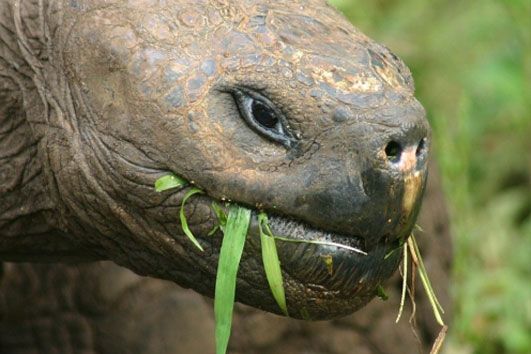
In very good news for conservation efforts in the Galapagos, the Daily Mail reported this week that one of the archipelago’s most iconic species had passed a milestone.  The Galapagos Tortoise population in the islands has surpassed 1,000, a remarkable figure considering that its numbers had dwindled to just 15 individuals in the 1970s.

The species that fascinated and inspired Charles Darwin as he developed his theories of evolution was nearly brought to extinction by human predation and habitat degradation.  A captive breeding program has brought the Galapagos tortoise back from the brink, and they can now be found on the islands of Santa Cruz, Santiago, Pinzen and Espanola. (Photo © Charles J. Sharp).

Conservation on land mirrors what happens below the surface — discover the protected waters at the best Galapagos dive sites.
Related Articles
There's no bad time to dive the Galapagos. Compare the warm and cool seasons, whale shark months and month-by-month conditions to plan your liveaboard trip.
Darwin and Wolf are the Galapagos' best dive sites: schooling hammerheads, whale sharks and the ocean's greatest shark diving — reached only by liveaboard.
Marine conditions in the Galapagos: warm and cool seasons, where hammerheads school year-round, and why Wolf and Darwin attract the biggest wildlife.
Tiburon Explorer’s itinerary

8 days/ 7 nights

Saturday: Baltra
Guests fly to the Galapagos Islands from Mainland Ecuador, arriving in the late morning (please make sure to land in Baltra not later than 11:30am). The dive guides will meet the guests at the airport between 11:00 am and 12 pm and escort them to the Galapagos liveaboard, Tiburon Explorer®. Guests will board the vessel, have lunch, organize equipment and listen to the safety briefings.

Sunday: Baltra North (2 Dives)
Equipment check, 7:00 and 10:00 dives.
Sightings include rays and schools of fish.
Afternoon North Seymour land visit. Walk the path around North Seymour Island to see the large colonies of Blue Footed Boobies and Frigate Birds. Sighting of Sea Lions and Marine Iguanas are also common. Depart for Cabo Douglas (11 hours).

Monday: Cabo Douglas (1-2 Dives)
Sightings include marine iguanas. Transit to Punta Vicente Roca.

Punta Vicente Roca (1-2 Dives)
Sightings often include mola mola, turtles and macro life. Transit to Wolf (10 hours).

Tuesday: Wolf Island (4 Dives)
6:30, 10:30, 2:00 and 4:30 dives. Sightings often include hammerheads, whale shark (in season), eagle rays, sea lions, Galapagos sharks and silky sharks.

Wednesday: Darwin Island (4 Dives)
6:30, 10:30, 2:00 and 4:30 dives.
Sightings often include hammerheads, whale sharks (in season) eagle rays, Galapagos sharks and silky sharks. 
Transit to Wolf Island.

Thursday: Wolf Island (3 Dives)
6:30, 10:30 and 1:00 dives.
Sightings often include hammerheads, whale sharks (in season), eagle rays, Galapagos sharks and silky sharks. Transit to Cousin’s Rock (20+ hours).

Friday: Cousins Rock (2 Dives)
6:30 and 9:30 dives.
This is a great macro diving with an excellent chance of seeing sea horses, sea lions and eagle rays. Lunch will be served while transiting to Santa Cruz (3 hours). Travel by bus to the Santa Cruz Highlands to visit the giant tortoises in their natural habitat. Transfer to the town of Puerto Ayora. Dinner on your own in Puerto Ayora. Return to the Tiburon Explorer at 8:30pm.

Saturday: Baltra
Depart the vessel by 9 am. Transfer to the airport.