
When visiting the Galapagos Islands, a National Park and World Heritage Site, all visitors are expected to act responsibly and to treat the environment with respect.
Below are 14 rules of the Galapagos National Park Directorate (GNPD) that all visitors are expected to abide by while in the Islands:
Galapagos Islands weather varies with the season. Air temperatures range from 75°F (24°C) or higher in the warm season (December–May) to the mid-60s°F (around 18°C) during the cool, dry season (June–November), with steady sea breezes.
Water temperatures range from 65–75°F (18–24°C) from December through May and 60–70°F (15–21°C) from June through November.
Visibility is generally between 30 and 80 feet. Currents can range from 1 to 5 knots at the places where we do dive.
Most divers are comfortable with a 7mm wetsuit from June to November, with a hooded vest and gloves, and a minimum 5mm wetsuit from December to May. A hood and gloves are strongly recommended as part of your scuba equipment.
Dive transfers are done from small boats (pangas), with an easy back-roll entry into the water.
Most scuba certification agencies allow divers to be certified from age 10, but junior divers are restricted to shallow depths. Since this itinerary includes no dives shallower than 40 feet and conditions demand solid skills, the minimum age for diving on our Galapagos liveaboards is 15 years old.
To safeguard your security, we require the following of all divers:
All linens (including sheets, comforters, bath towels, hand towels, dive towels, and wash cloths) and soaps are provided on board. Hairdryers are not supplied, so bring your own if you need one.
If possible, pack your regulator, dive computer, mask, a swimsuit, change of clothes, medications and toiletries in your carry-on bag. Having these few items with you will make an unexpected luggage delay far more bearable.
There is a weight limit on checked-in luggage for flights to and from Quito and/or Guayaquil to the Galapagos of 44 pounds (20 kilos). An additional fee of up to US$1.70* per 2.2 pounds (1 kilo) to and from Quito will be charged for luggage over the limit and US$1.50* per 2.2 pounds (1 kilo) to and from Guayaquil. In addition, passengers are allowed a carry-on bag weighing no more than 17.6 pounds (8 kilos) and a personal item. All additional luggage fees must be paid in cash at flight time.
The vessel provides tanks, weights, and weight belts for your use. If you prefer to rent the rest of your equipment from us, we have all of the equipment that you will need. Please indicate on your application form what equipment you will require. Otherwise, the following items are the diver’s responsibility:
* Available for rent on board Most of our guests bring their own complete set of dive gear. This is the ideal situation, however, due to weight limits or additional travel plans some of our guests choose to rent gear. We strongly recommend that you bring your own mask, gloves, booties, fins, hood or hooded vest and computer. A personal wetsuit is also a good idea if you have space. Diving in Galapagos can be challenging and it is important that you are comfortable.
Due to the remote nature of the destination, all divers are required to carry valid dive accident insurance — such as DAN or DiveAssure — when diving aboard the Tiburon Explorer or Humboldt Explorer, and to note the policy number on their application form.
Passports are required for all arriving foreign nationals. If in doubt about visas, contact the Ecuadorian Consulate for specific requirements from your country.
Galapagos National Park entrance fee: USD $200 per person. Galapagos Transit Control Card (Ingala): USD $20 per person. Both fees are payable in cash on arrival.
Flight times, prices and the Galapagos airport of arrival are all subject to change with little or no notification, and flights often run late. We strongly encourage our guests to plan on arriving at least one and preferably two days prior to your flight to the Galapagos Islands, to ensure that your luggage is with you or to make up for any travel delays. We also recommend that guests plan on an extra night in Guayaquil or Quito upon departing Ecuador.
The earliest time a guest can reliably expect to connect to another flight is 10 p.m on the last day of the trip. Ticket holders are required to check-in a minimum of three hours prior to flight time for all international departures, even when connecting from LATAM or Avianca flights.
Please list on the application form any dietary needs you have.
Aboard the Tiburon Explorer and Humboldt Explorer, lunch and evening meals usually consist of lots of salad, potatoes, rice, chicken, beef, pork, and fish. Breakfast is the usual fare of eggs, ham, cereal, toast, and fresh fruits. Cookies are available between dives. If you have any dietary restrictions or requests, please indicate so on your application form. Please note that specific brands of soft drinks, dressings and foods are often unavailable in the islands, and that it can be very difficult for us to find low-fat or soy products, fresh fruit, fish, and other items common elsewhere. While we will do our best to accommodate your requests, please be realistic and consider bringing some of your own foods if the lack thereof may constitute a health risk or seriously compromise your enjoyment of your holiday.
US dollars are widely accepted
The U.S. dollar is the official currency of Ecuador; therefore, it is not necessary to purchase currency before arriving. Most major credit cards are widely accepted when shopping ashore; however, additional fees (typically around 8%) are charged in Ecuador for credit card use.
Major credit cards are accepted on board
Crew gratuities are not included in your package. The crew works very hard, 7 days a week and up to 12 weeks at a stretch, providing the best possible service for our guests. The industry standard for crew gratuities on dive trips (if, of course, you are happy with the service you have received) is around 10% of the package price per passenger.
Your generosity will be greatly appreciated
The beauty of liveaboard diving is that you can access remote areas, beyond the reach of land-based operations. At its best, this means diving in places far from human contact where marine life is diverse and plentiful. Nowhere in the world is this more evident than when you set foot on a Galapagos Islands liveaboard and set off for a cruise around this legendary archipelago.
Those that find themselves in this fortunate position tend to be experienced divers who have been to various destinations and dived in a range of conditions. To such divers, Galapagos liveaboards are something of a Holy Grail, a destination they knew they would get to ‘one day’ and they finally made it happen. It certainly is not a beginner diver destination since the diving conditions require a certain level of experience and composure in the water. When those elements are present, diving in the Galapagos Islands can be mind-blowing.
Each adventure below the waves promises extraordinary sightings. Commonly you will come back from the Galapagos with underwater memories of schools of hammerhead sharks, pods of dolphins, manta rays, sea lions, penguins and marine iguanas. The excited post-dive chatter in the Galapagos Islands is like nowhere else.
As if this was not enough, you will also enjoy one or two brief educational land visits included in the itinerary.
You will likely learn more about the local ecosystems and the role that the archipelago’s rich wildlife played in affirming Darwin’s revolutionary studies of evolution by natural selection. In all, Galapagos diving cruises are a privilege for any lover of nature and will live forever in the memory of those lucky enough to have made a trip happen.
These 2 islands in the north-west of the archipelago are the undoubted stars of the show. You will do more dives here than anywhere else since they form the back-bone of any meaningful Galapagos liveaboard dive itinerary. The journey is too far to make them accessible as sites for a land-based operator.
Choppy seas, current and surge are all common in this area.
However, the marine sightings are such that these discomforts can easily be forgiven. Whether as drift dives or dives spent observing the action in sheltered spots, in these areas hammerheads, Galapagos sharks, eagle rays, dolphins, whale sharks and more are common. These are also the warmest waters in the archipelago so the reef fish and corals (albeit limited) are more tropical than further south.
While there are other areas of the Galapagos where you will have exciting underwater encounters, the days spent diving Wolf and Darwin will probably dominate your most cherished memories.
The story of the Galapagos is not all about Wolf and Darwin. Other areas will likely play an important role in your diving experience here. You will usually start with a check-out dive near your point of embarkation, and most of your other dives will take place in the central region of the archipelago.
Some of the best Galapagos dive sites in this region are around the north of the island of Isabela, where sites like Roca Redonda and Cabo Marshall are found. There is also the unforgettable Punta Vicente Roca, which is like suddenly diving in a different country. You will also likely dive in the highly photogenic Cousin’s Rock near Santiago Island.
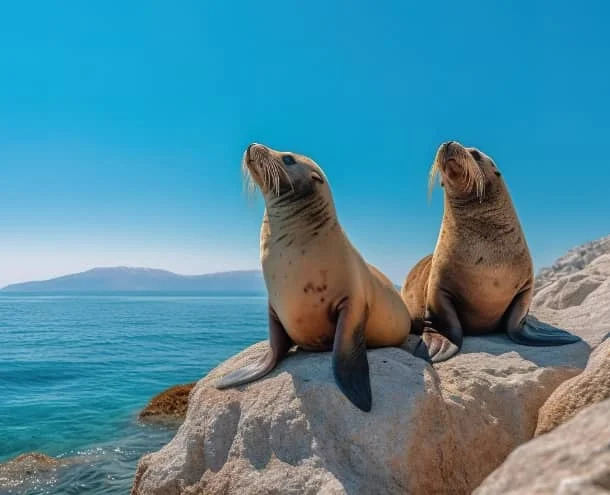
Here the water is always cooler than in the far north, so there are fewer warm water species. Punta Vicente Roca is always the coolest site in more ways than one. Chilly temperatures combine with amazing sightings including sunfish, Galapagos horn sharks, penguins and red-lipped batfish, making it an undoubted highlight. You can expect amazing encounters with rays (manta rays, mobula rays, cow nose rays) at Cabo Marshall. Throughout the central region there are opportunities for diving with hammerhead sharks, Galapagos sharks and turtles, as well as sea lions and, occasionally, fur seals.
The Galapagos Islands experience equatorial weather with two diving seasons. The warm season, from roughly December to May, brings brief showers, calmer seas and warmer water — typically 65–75°F (18–24°C) — along with superb manta ray encounters. The cool, dry season, from roughly June to November, is driven by the nutrient-rich Humboldt Current: water temperatures drop to 60–70°F (15–21°C), plankton blooms draw in massive marine life, and this is whale shark season at Darwin. Scalloped hammerhead sharks school in Galapagos year-round.
This is not an exact science, of course, and you are advised to bring exposure protection to cover the full range of temperatures. For a month-by-month breakdown, see our guide to the best time to dive the Galapagos.