Iguana’s Paradise

Updated on October 13, 2026
Iguana’s Paradise

The world renowned geologist Teodoro Wolf states that the iguana that abounds in South America is the last living representative of the dinosaur age that dates back millions of years ago. In the Enchanted Islands there are two types of iguanas: the marine and the terrestrial, both very distinctly different in size and general appearance.  Let’s take a look

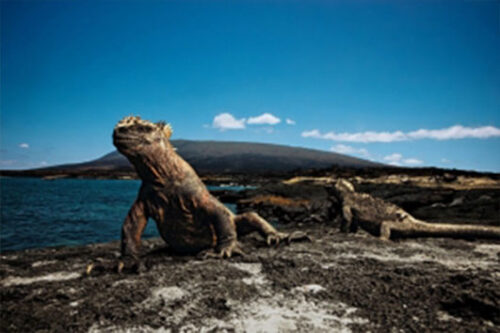
The Galapagos marine iguana is an endemic variety that flourishes in the rocky areas of the island’s north and south. Scientifically known as Amblyrhynchus cristatus, this scaly reptile species is unique to say the least. This reptile has the ability to remain under water for 45 minutes, at a depths of 15 meters in search of fresh, green aquatic vegetation that is its primary source of food.. It is truly an amazing sight to admire this prehistoric creature sunning its self, or gorging on algae along the spectacular beaches that surround the islands.

Iguanas with their flat tails, long claws and three sharp teeth have the ability to attach themselves to the rocks and not be swept away by the tides and currents of the sea. Their bodies measure between 80 to 90 centimeters in length, and are covered from head to tail to protect themselves.  Perhaps this is how they were able to survive. Making them even more adaptable, they possess a smooth snout and dorsal fin allowing them to glide through the water like a fish making them even more elusive.

Marine iguanas have the ability to move blood away from their outer protective layer like a cold blooded fish to keep warm. And also has the ability to dramatically reduce its heart rate to conserve energy in a dormant state. They also possess the ability to separate salt from the ocean waters through a gland near their nose.

The land iguana starkly characterized by brilliant colors of yellow, red and brown tones is an entirely different looking cousin of the aquatic lizard. It has an entirely different preference for its’s diet. Cactus, Palo Santo leaves and plants of the insular area like algae and Muyu are among some of its favorites. Also in contrast, with lizard protects it’s self from foes by hiding in burrows they dig deeply in the arid desert like portions of the islands. Alarmingly, this land based variant’s numbers have been decreasing, but still flourish in Fernandina thanks to the tremendous conservation efforts.

The land based iguana being an endemic reptile, is more commonly seen in the arid environments of Isabela, Santa Cruz, Fernandina islands and Plaza.

The most colorful variations with brilliant colorations of reds and greens, reside in Española Island; however the largest of the land based are typically seen on Isabela and Fernandina Island, and for some reason their smaller cousins preferring Genovesa Island.

Manmade issues constantly pose a threat to both land and marine iguanas threating their numbers. That dwells on and off the water creates problems for them. Fishing nets can be deadly for the marine breed, while plastic water bottles, and other debree is a issue for the land based lizards.  Please keep this in mind during your visit, and help perserve this one of a kind creature.

Marine iguanas are just one of the encounters waiting below the surface — see all the highlights at the best Galapagos dive sites.

Related Articles
Galapagos runs on UTC-6 all year: 7 to 9 hours behind Central and Eastern Europe, 1 hour behind mainland Ecuador. Plan flights, jet lag and
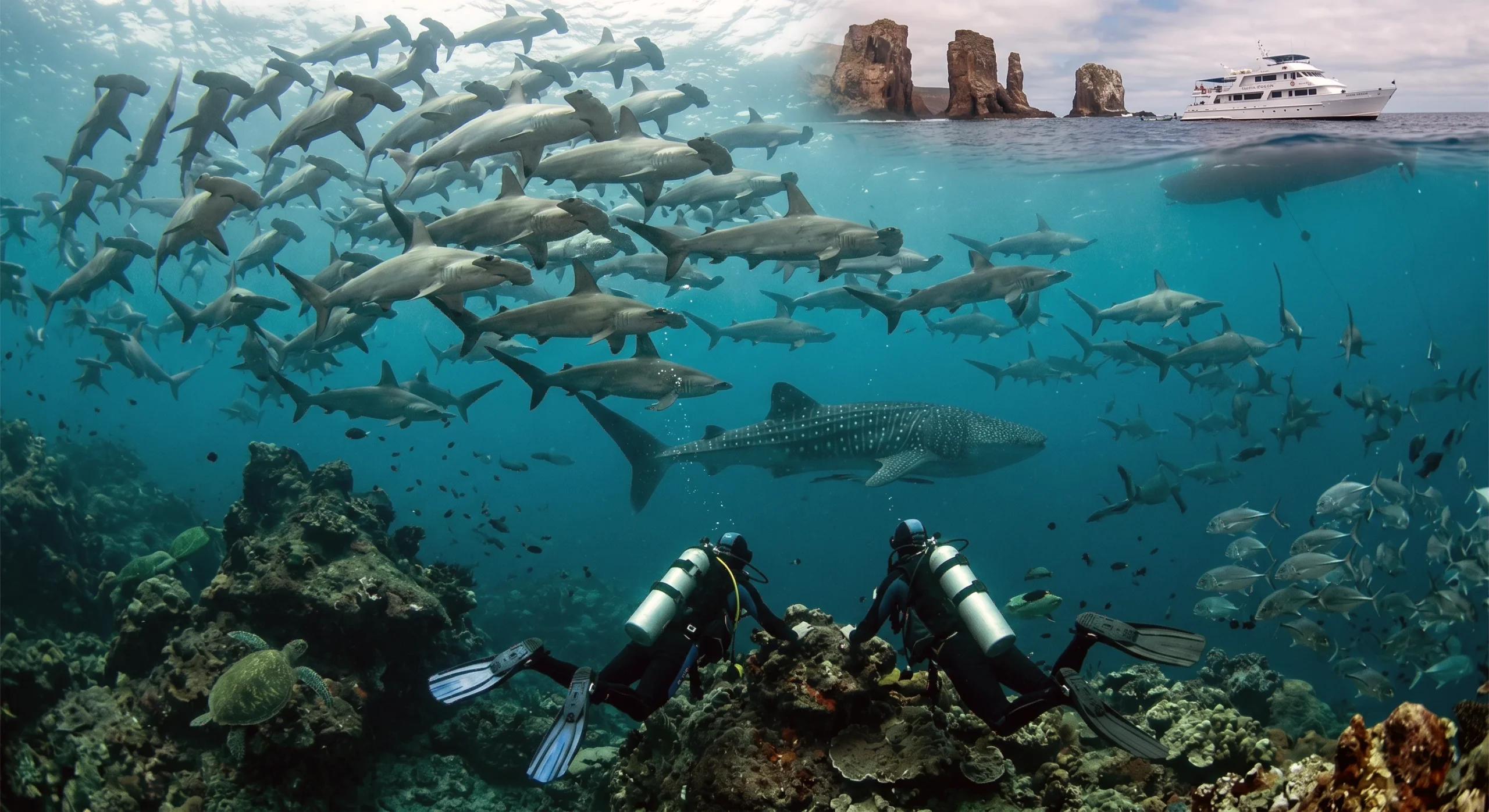
Dive with huge schools of hammerhead sharks in the Galapagos: where to see them, the best season and why Darwin and Wolf hold the biggest
What to wear in the Galapagos: light layers on deck, plus the wetsuit, hood and gloves divers pack for Darwin and Wolf. Simple packing list

Itineraries - Humboldt Explorer

8 days/ 7 nights

Please note  that all trips onboard Humboldt Explorer are now operated from Baltra to Baltra (Airport code GPS). We will not sail from/to San Cristobal island anymore.

Monday: Baltra
Guests fly to the Galapagos Islands from Mainland Ecuador, arriving in the late morning (please make sure to land in Baltra not later than 11:30am). The dive guides will meet the guests at the airport between 11:00 am and 12 pm and escort them to the Galapagos liveaboard, Humboldt Explorer. Guests will board the vessel, have lunch, organize equipment and listen to the safety briefings.

Tuesday: Baltra North (2 Dives)
Equipement check, 7:00 and 10:00 dives.
Sightings include rays and schools of fish.
Afternoon North Seymour land visit. Walk the path around North Seymour Island to see the large colonies of Blue Footed Boobies and Frigate Birds. Sighting of Sea Lions and Marine Iguanas are also common.
Depart for Northern Islands (long transit).

Wednesday: Wolf Island (3-4 Dives)
10:30, 2:00 and 4:30 dives. Possible night dive.
Sightings often include hammerheads, whale sharks, eagle rays, sea lions, Galapagos sharks, and silky sharks.
Night anchor at Wolf Island.

Thursday: Wolf Island (2 Dives)
6:30 and 9:30 dives.

Transit to Darwin Island (2 Dives)
2:00 and 4:30 dives.
Sightings often include hammerheads, red-lipped batfish, eagle rays, sea lions, Galapagos sharks, and silky sharks.

Friday: Darwin Island (4 Dives)
6:30, 10:30, 2:00 and 4:30 dives.
Sightings often include hammerheads, whale sharks (in season) eagle rays, Galapagos sharks, and silky sharks.
Transit to Wolf Island.

Saturday: Wolf Island (3 Dives)
6:30, 9:00 and 11:00 dives.
Sightings often include hammerheads, whale sharks (in season), eagle rays, Galapagos sharks, and silky sharks.
Long transit to Cousin’s Rock (20+ hours).

Sunday: Cousin’s Rock (1-2 Dives)
6:30 and 9:30 dives (number of dives dependent on travel time from Wolf Island).
This is great macro diving with an excellent chance of seeing sea horses, sea lions, and eagle rays. Lunch will be served while transiting to Santa Cruz (3 hours). Travel by bus to the Santa Cruz Highlands to visit the giant tortoises in their natural habitat. Visit the town of Puerto Ayora and the Darwin Centre on your own. Dinner on your own in Puerto Ayora. Return to the Humboldt Explorer at 8:30 pm.

Monday: Baltra
Depart the vessel by 9 am. Transfer to the airport.

Rates - Humboldt Explorer

Single supplement (for not sharing cabin) 80%.
All pricing is in US Dollars, per person double occupancy.

7 – Night Trips: 
January – June 2026$6,295
July 2026 – June 2027$6,395
July 2027 – June 2029$6,495
July 2029 – Dec. 2030$6,695
10 – Night Trips: 
No information yet – Ask: Form or WhatsApp 


INCLUDED

  • 7 nights/8 days or 10 nights/11 days aboard the vessel
  • Up to 4 dives daily (Weather Permitting).
  • 3 meals daily, except Sunday’s evening meal
  • Between-dive snacks
  • Towels, linens
  • Use of tanks, weights and weight belts
  • All air fills
  • Transfers between vessel and airport for same day arrivals & departures
  • Local alcohol
  • Non-alcoholic beverages

NOT INCLUDED:

  • Flights to/from Galapagos
  • Dive gear rental (Wetsuit, BCD, regulator, dive computer, fins, masks, booties, gloves, hoods)
  • Crew gratuities
  • Trip Cancellation & Dive Accident Insurance
  • Premium Alcoholic Beverages
  • Galapagos National Park tax – USD 200 per person, cash only.
  • Ingala Transit Card USD 20 per person, cash only).
  • Nitrox: USD 150 per person.
  • Fuel tax USD 150 per person

Diving Equipment Rental Prices Per Person Per Week

  • Full Scuba Package -BCD, Regulator, Console, wetsuit (does not include computer) $ 250
  • Regulator Package with gauges, octopus and inflator $ 90
  • Computer $ 100
  • BCD $ 90
  • Full Body Wetsuit $ 75 (7mm)
  • Mask & Snorkel $ 25
  • Fins/booties $ 50
  • DIN/Yoke Adaptor (limited availability) $ 25
  • 15 Liters Tank $ 130

Payment Terms

Deposit Required Upon Reservation: 30% of regular rate

Final Payment / Balance Due: 90 days prior departure

Individual Cancellation Terms

8 months to 12 months before departure: 10% of regular rate

6 months to 8 months before departure: 20% of regular rate

90 days to 6 months before departure: 30% of regular rate

89 to 0 days before departure: 100% of regular rate


Group Cancellation Terms

12 months to 18 months before departure: 5% of regular rate

8 months to 12 months before departure: 10% of regular rate

6 months to 8 months before departure: 20% of regular rate

90 days to 6 months before departure: 30% of regular rate

89 to 0 days before departure: 100% of regular rate

Tiburon Explorer’s itinerary

8 days/ 7 nights

Saturday: Baltra
Guests fly to the Galapagos Islands from Mainland Ecuador, arriving in the late morning (please make sure to land in Baltra not later than 11:30am). The dive guides will meet the guests at the airport between 11:00 am and 12 pm and escort them to the Galapagos liveaboard, Tiburon Explorer®. Guests will board the vessel, have lunch, organize equipment and listen to the safety briefings.

Sunday: Baltra North (2 Dives)
Equipment check, 7:00 and 10:00 dives.
Sightings include rays and schools of fish.
Afternoon North Seymour land visit. Walk the path around North Seymour Island to see the large colonies of Blue Footed Boobies and Frigate Birds. Sighting of Sea Lions and Marine Iguanas are also common. Depart for Cabo Douglas (11 hours).

Monday: Cabo Douglas (1-2 Dives)
Sightings include marine iguanas. Transit to Punta Vicente Roca.

Punta Vicente Roca (1-2 Dives)
Sightings often include mola mola, turtles and macro life. Transit to Wolf (10 hours).

Tuesday: Wolf Island (4 Dives)
6:30, 10:30, 2:00 and 4:30 dives. Sightings often include hammerheads, whale shark (in season), eagle rays, sea lions, Galapagos sharks and silky sharks.

Wednesday: Darwin Island (4 Dives)
6:30, 10:30, 2:00 and 4:30 dives.
Sightings often include hammerheads, whale sharks (in season) eagle rays, Galapagos sharks and silky sharks. 
Transit to Wolf Island.

Thursday: Wolf Island (3 Dives)
6:30, 10:30 and 1:00 dives.
Sightings often include hammerheads, whale sharks (in season), eagle rays, Galapagos sharks and silky sharks. Transit to Cousin’s Rock (20+ hours).

Friday: Cousins Rock (2 Dives)
6:30 and 9:30 dives.
This is a great macro diving with an excellent chance of seeing sea horses, sea lions and eagle rays. Lunch will be served while transiting to Santa Cruz (3 hours). Travel by bus to the Santa Cruz Highlands to visit the giant tortoises in their natural habitat. Transfer to the town of Puerto Ayora. Dinner on your own in Puerto Ayora. Return to the Tiburon Explorer at 8:30pm.

Saturday: Baltra
Depart the vessel by 9 am. Transfer to the airport.