
Galapagos and Ecuador Time Zone

| Updated on July 26, 2026

The Ecuadorian mainland is five hours behind Greenwich Mean Time, and the Galapagos are six hours behind, one hour behind Ecuador’s continental time, so keep that in mind when figuring out airplane connections.

A few day yachts operate on mainland time to simplify contact with their offices.

Ecuadorian time is in the same time zone as the Eastern Standard Time Zone of the United States.

One more scheduling tip: check the best time to dive the Galapagos before you lock in flights — every season has its highlights, from whale sharks to schooling hammerheads.

Frequently Asked Questions About Galapagos Time

The Galapagos Islands are six hours behind Greenwich Mean Time (GMT-6), one hour behind mainland Ecuador. Mainland Ecuador shares its time with the U.S. Eastern Standard Time zone.

No. Ecuador and the Galapagos keep the same time all year round, so the one-hour difference between the islands and the mainland never changes.

Airline tickets show local times, so a 1.5-hour flight from Guayaquil appears to land only 30 minutes after departure. Keep the one-hour gap in mind when planning connections.
Related Articles
Thinking of a 5-day Galapagos liveaboard? Why 7 nights is the standard for Darwin and Wolf, what the extra days give you, and which length
What to wear in the Galapagos: light layers, a windbreaker and serious sun protection — plus the right wetsuit for every diving season.
Let’s go to Galapagos: a spectacular year-round destination with marine iguanas, sea lions, schooling hammerheads and rare species at every turn.
Tiburon Explorer’s itinerary

8 days/ 7 nights

Saturday: Baltra
Guests fly to the Galapagos Islands from Mainland Ecuador, arriving in the late morning (please make sure to land in Baltra not later than 11:30am). The dive guides will meet the guests at the airport between 11:00 am and 12 pm and escort them to the Galapagos liveaboard, Tiburon Explorer®. Guests will board the vessel, have lunch, organize equipment and listen to the safety briefings.

Sunday: Baltra North (2 Dives)
Equipment check, 7:00 and 10:00 dives.
Sightings include rays and schools of fish.
Afternoon North Seymour land visit. Walk the path around North Seymour Island to see the large colonies of Blue Footed Boobies and Frigate Birds. Sighting of Sea Lions and Marine Iguanas are also common. Depart for Cabo Douglas (11 hours).

Monday: Cabo Douglas (1-2 Dives)
Sightings include marine iguanas. Transit to Punta Vicente Roca.

Punta Vicente Roca (1-2 Dives)
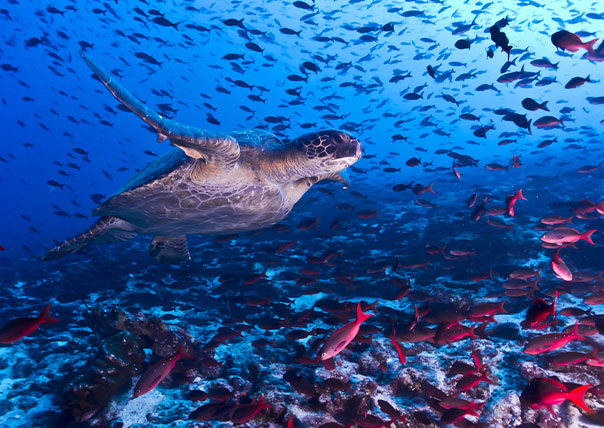
Sightings often include mola mola, turtles and macro life. Transit to Wolf (10 hours).

Tuesday: Wolf Island (4 Dives)
6:30, 10:30, 2:00 and 4:30 dives. Sightings often include hammerheads, whale shark (in season), eagle rays, sea lions, Galapagos sharks and silky sharks.

Wednesday: Darwin Island (4 Dives)
6:30, 10:30, 2:00 and 4:30 dives.
Sightings often include hammerheads, whale sharks (in season) eagle rays, Galapagos sharks and silky sharks. 
Transit to Wolf Island.

Thursday: Wolf Island (3 Dives)
6:30, 10:30 and 1:00 dives.
Sightings often include hammerheads, whale sharks (in season), eagle rays, Galapagos sharks and silky sharks. Transit to Cousin’s Rock (20+ hours).

Friday: Cousins Rock (2 Dives)
6:30 and 9:30 dives.
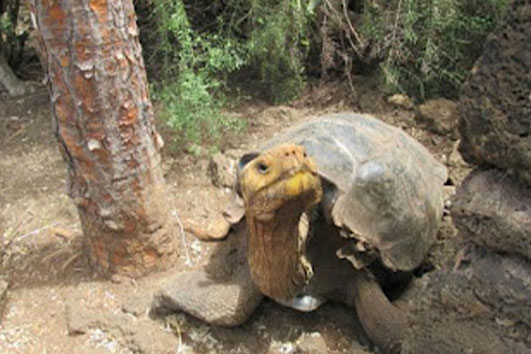
This is a great macro diving with an excellent chance of seeing sea horses, sea lions and eagle rays. Lunch will be served while transiting to Santa Cruz (3 hours). Travel by bus to the Santa Cruz Highlands to visit the giant tortoises in their natural habitat. Transfer to the town of Puerto Ayora. Dinner on your own in Puerto Ayora. Return to the Tiburon Explorer at 8:30pm.

Saturday: Baltra
Depart the vessel by 9 am. Transfer to the airport.