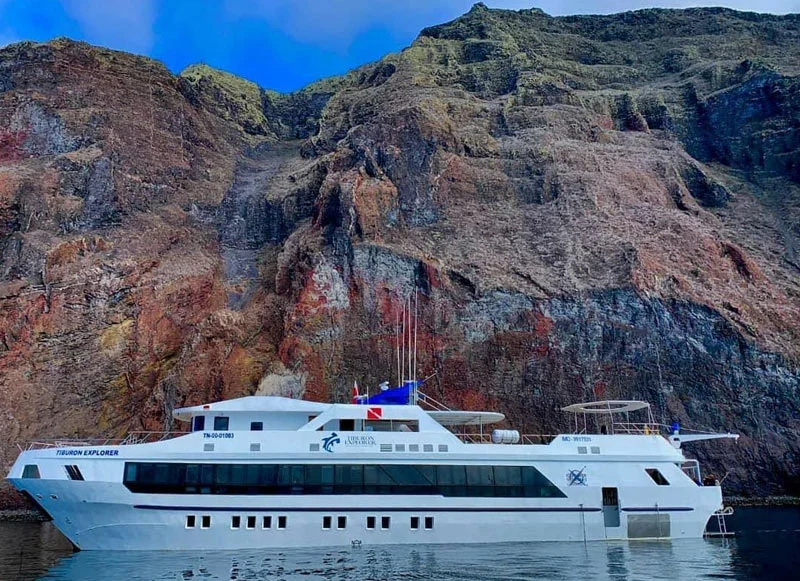
A seven-night Galapagos liveaboard trip aboard the Tiburon Explorer or Humboldt Explorer costs $6,395 to $7,395 per person right now, with rates set through December 2030 (see the table below) and vessel and cabin category also affecting the price. Longer 10-night trips are also available, and their rates are further down this page.
That price covers your cabin, all meals, up to four dives a day, tanks and weights, and domestic drinks on board. Flights to the Galapagos, gratuities, dive insurance and a handful of mandatory local fees are paid separately. Below we break down exactly what’s included, what isn’t, and what a realistic total budget looks like.
Rates are per person for the standard 7-night, 8-day itinerary. For trips departing after December 2030, contact us directly for current pricing.
Flying in from Europe? See what the whole trip costs in euros, flights included.
What's included in your Galapagos liveaboard package
- 7 nights and 8 days aboard the vessel
- Three meals a day, plus snacks between dives
- Two to four dives a day (18 to 19 dives over the full week)
- Use of tanks, weights and belts
- All domestic alcoholic and non-alcoholic drinks on board
- Airport transfers between Baltra (GPS) and the boat, on your arrival and departure day
What's not included
A few things are left out of the package price, and it’s worth planning for them ahead of time:
- Hotel nights before or after your trip
- Flights to and from the Galapagos
- The last evening’s dinner
- Equipment rental and nitrox
- Crew gratuities
- Trip cancellation and dive accident insurance
- Premium alcoholic drinks
- The hyperbaric chamber support fee (see the mandatory fees below for the exact amount)
Mandatory fees you'll pay in the Galapagos
On top of your package, every diver pays a set of mandatory fees in cash — some before you leave the mainland, and some once you arrive in the Galapagos. These aren’t optional, and they’re the same regardless of which vessel you choose.
| Fee | Cost (per person) | Paid |
|---|---|---|
| Galapagos National Park entrance fee | $200 | Cash, on arrival in the Galapagos |
| Galapagos Transit Control Card (Ingala) | $20 | Cash, at the mainland airport before departure |
| Fuel tax | $150 | Cash, on board |
| Chamber Support Fee | $35 | Cash, on board |
Together, these mandatory fees add up to $405 per person — worth budgeting for on top of your package price.
Equipment rental prices, if you need gear
If you’re not bringing your own dive gear, both vessels offer rental equipment at the same rates:
| Item | Price (per trip) |
|---|---|
| Full scuba package (BCD, regulator, console, wetsuit — no computer) | $250 |
| Regulator package (gauges, octopus, inflator) | $90 |
| Dive computer | $100 |
| BCD | $90 |
| Full-body 7mm wetsuit | $75 |
| Dive mask | $25 |
| Fins and booties | $50 |
| DIN/Yoke adaptor | $25 |
| 15-liter tank | $130 |
| Nitrox (optional, per trip) | $150 |
How much should you budget in total?
Galapagos liveaboard prices vary by vessel, cabin and season. On the Tiburon Explorer and Humboldt Explorer, a seven-night package runs $6,395 to $7,395 per person right now, with rates rising by $100 in July 2027 and by another $200 in July 2029, and set through December 2030.
The table below shows the current rate by vessel and season, followed by the extra costs — flight, mandatory fees and gratuities — you’ll want to plan for on top of the package.
| Season | Tiburon Explorer | Humboldt Explorer |
|---|---|---|
| January – June 2026 | $7,295 | $6,295 |
| July 2026 – June 2027 | $7,395 | $6,395 |
| July 2027 – June 2029 | $7,495 | $6,495 |
| July 2029 – December 2030 | $7,695 | $6,695 |
Rates are per person for the standard 7-night, 8-day itinerary. For trips departing after December 2030, contact us directly for current pricing.
What does a 10-night trip cost?
Longer trips of 10 nights and 11 days are also available. Here is the package price per person, sharing a cabin:
| Season | Tiburon Explorer | Humboldt Explorer |
|---|---|---|
| July 2026 – June 2027 | $9,995 | $8,995 |
| July 2027 – December 2027 | $9,995 | $9,295 |
| January 2028 – June 2029 | $10,295 | $9,295 |
| July 2029 – June 2030 | $10,595 | $9,795 |
| July 2030 – December 2030 | $10,795 | $9,795 |
Flights, mandatory fees and gratuities are paid separately, as on the 7-night trip. Contact us for the exact total for your dates.
On top of the package price, budget for these per-person extras:
| Item | Estimated cost |
|---|---|
| Round-trip flight to the Galapagos | $550 – $650 (around $600) |
| Mandatory fees (park, transit card, fuel, chamber) | $405 |
| Crew gratuities (about 10%) | ~$500 |
This doesn’t include a hotel night before or after your trip (around $120 per night in Guayaquil), dive accident insurance, or any equipment rental — add those in based on what applies to you. Flights run roughly $550 to $650 depending on season and airline; we’ve used $600 as the midpoint above.
Tiburon Explorer vs Humboldt Explorer: why the price differs
| Tiburon Explorer | Humboldt Explorer | |
|---|---|---|
| Class | Luxury | First-class |
| Staterooms | Larger, including 3 suites | Standard staterooms |
| Itinerary | 7 nights — Darwin, Wolf & western sites | 7 nights — Darwin & Wolf |
| Western sites (Cabo Douglas, Punta Vicente Roca) | Yes | No |
| Departure / return day | Saturday – Saturday | Monday – Monday |
| Price tier | Higher | Lower |
Discounts and ways to save
A few discounts are available, depending on how and when you book:
- Group discounts for parties of 6 or more divers traveling together
- Returning-guest discounts for divers who have sailed with us before
- Early-booking discounts for reservations made well ahead of your trip
Get in touch for current terms and to see what applies to your dates.
Ready to plan your trip?
Get an exact quote for your dates, cabin and group size. Chat with us on WhatsApp.
Dive insurance (required)
Every diver is required to carry valid dive accident insurance — DAN or DiveAssure, depending on where you’re traveling from — before boarding either vessel. Costs vary by provider and coverage level, so it’s not included in the estimate above. For the full requirement, see our Galapagos information guide .
Payment terms
Booking requires a 30% deposit, with the balance due 90 days before departure. We accept credit card and bank transfer; a 8% surcharge applies to credit card payments.
Frequently asked questions about Galapagos liveaboard cost
How much does a Galapagos liveaboard cost?
A seven-night Galapagos liveaboard trip costs $6,395 to $7,395 per person right now, with rates set through December 2030, depending on the vessel and cabin category. That covers your cabin, meals, diving and domestic drinks — flights, fees and gratuities are extra.
What's a realistic total budget for a Galapagos liveaboard trip?
Including your package, flight, mandatory fees and gratuities, plan on roughly $7,900 to $8,900 per person for a seven-night trip on the Tiburon Explorer or Humboldt Explorer. That excludes an optional hotel night, dive insurance and any equipment rental, which vary by traveler.
What's included in the price of a Galapagos liveaboard?
Your cabin for 7 nights, three meals a day plus dive snacks, two to four dives daily, tanks and weights, all domestic drinks, and airport transfers on your arrival and departure day.
What extra costs should I expect on a Galapagos liveaboard trip?
Beyond the package, plan for your flight to the Galapagos (around $600 round-trip), $405 in mandatory local fees, crew gratuities (about 10%), and dive insurance. Equipment rental and a pre- or post-trip hotel night are optional extras.
How much are the Galapagos National Park fee and other mandatory fees?
The Galapagos National Park entrance fee is $200 per person, the Transit Control Card is $20, the fuel tax is $150, and the chamber support fee is $35 — all paid in cash, for a total of $405 per person.
Is dive insurance required for a Galapagos liveaboard?
Yes. Every diver must carry valid dive accident insurance, such as DAN or DiveAssure, before boarding. It isn’t included in the package price and costs vary by provider.
How much should I budget for crew gratuities?
The standard is around 10% of your package price, which typically works out to about $500 per guest for the week.
Are there discounts available for a Galapagos liveaboard?
Yes — group discounts for parties of 6 or more, returning-guest discounts, and early-booking discounts are all available. Get in touch for current terms.