How to Get to Galapagos from Europe: Flights, Route and Timing

Updated on October 23, 2026
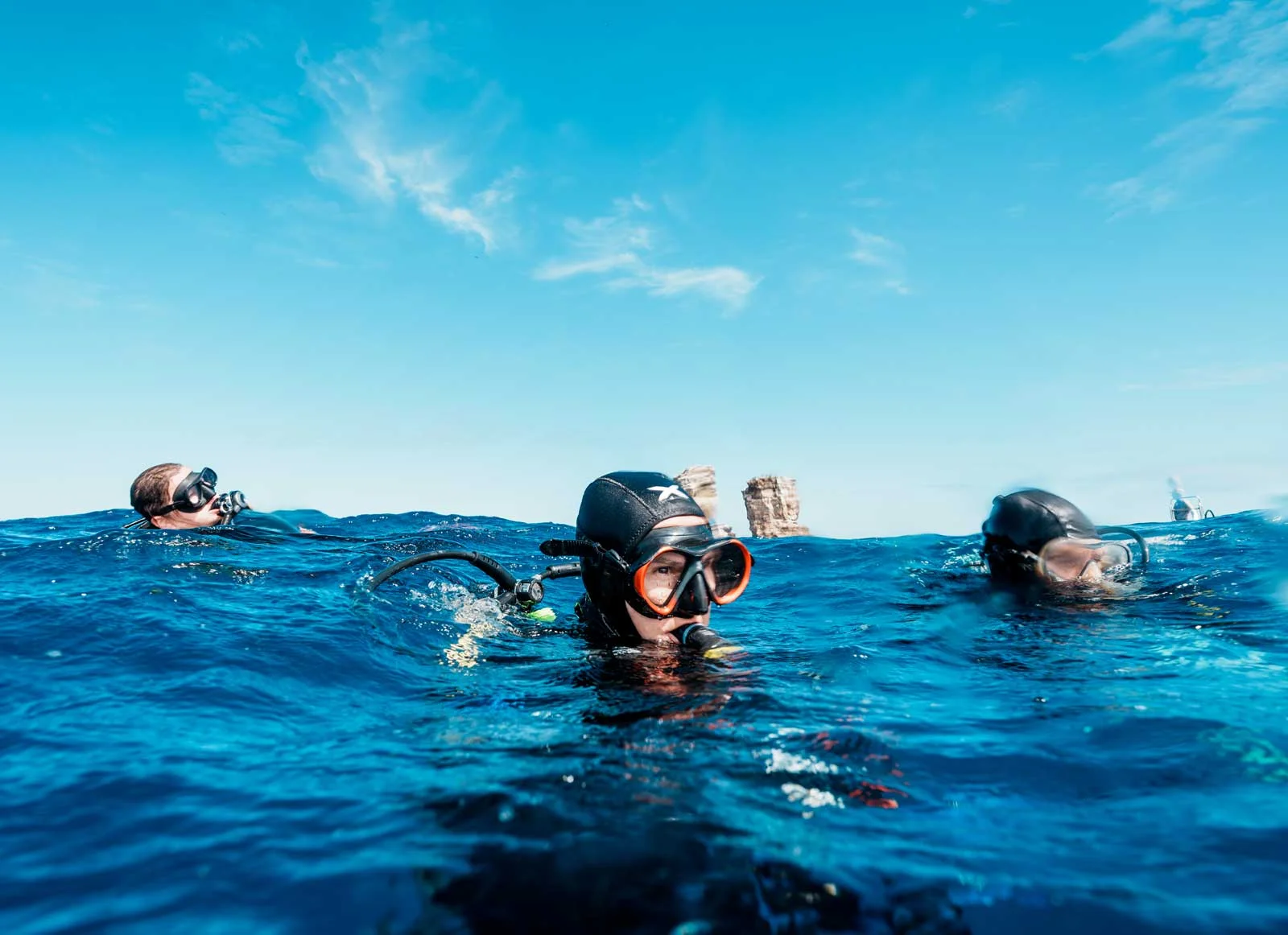
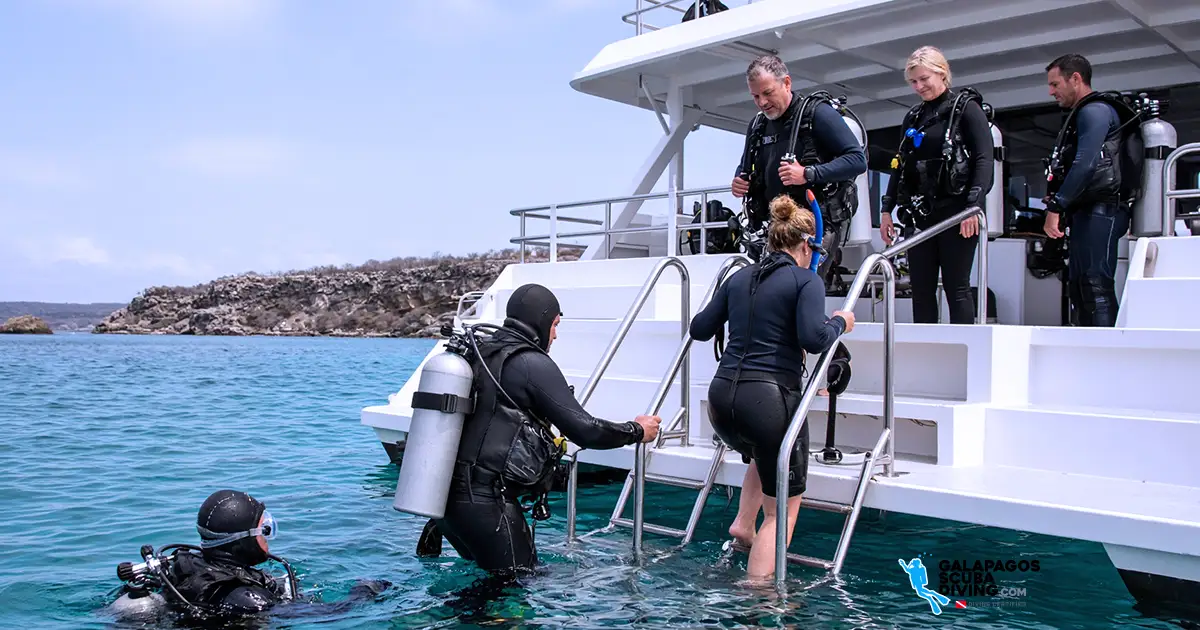
Divers boarding a Galapagos liveaboard after the flight from Europe to Baltra

Fly direct to Guayaquil from Madrid (Air Europa) or Amsterdam (KLM) in about 12 hours, then take a flight of about 2 hours to Baltra, the island airport where your liveaboard starts. From Warsaw, Prague, Bucharest or Budapest, add one connection. Land in Baltra before 11:30 am, and sleep a night in Guayaquil first, so a delay never costs you the boat.

No airline flies straight from Europe to the Galapagos, but the trip is simpler than it sounds: two flights and one night in between. Here is the route, the airlines, the timing and the small decisions that keep your dive week safe.

What is the route from Europe to the Galapagos?

Every journey follows the same three legs: Europe to Guayaquil, a night to rest, then Guayaquil to Baltra. Our Tiburon Explorer itinerary starts on a Saturday and our Humboldt Explorer itinerary on a Monday, so plan your flights around that day.

Step What happens Good to know
1. Europe to Guayaquil Direct from Madrid or Amsterdam, or with one connection About 12 hours when direct
2. Night in Guayaquil Rest and keep a safety margin Hotels cost around $120 a night
3. Guayaquil to Baltra Morning flight to the island airport (code GPS) About 2 hours; land before 11:30 am
4. Meet your dive guides They wait at the airport between 11:00 am and 12:00 pm and take you to the boat The airport shuttle fare is already covered; lunch, gear check and safety briefing follow
5. Seven nights aboard Wolf, Darwin and Cousin’s Rock Eight days in total
6. Back to Baltra Leave the boat by 9:00 am and transfer to the airport Fly to Guayaquil
7. Night in Guayaquil, then home Take the long-haul flight the next day Evening flights are common

Allow 10 to 12 days from door to door for a 7-night trip, depending on your connections; the 10-night option adds three days. Check exact dates on the Tiburon Explorer departures and Humboldt Explorer departures pages.
Get in touch:

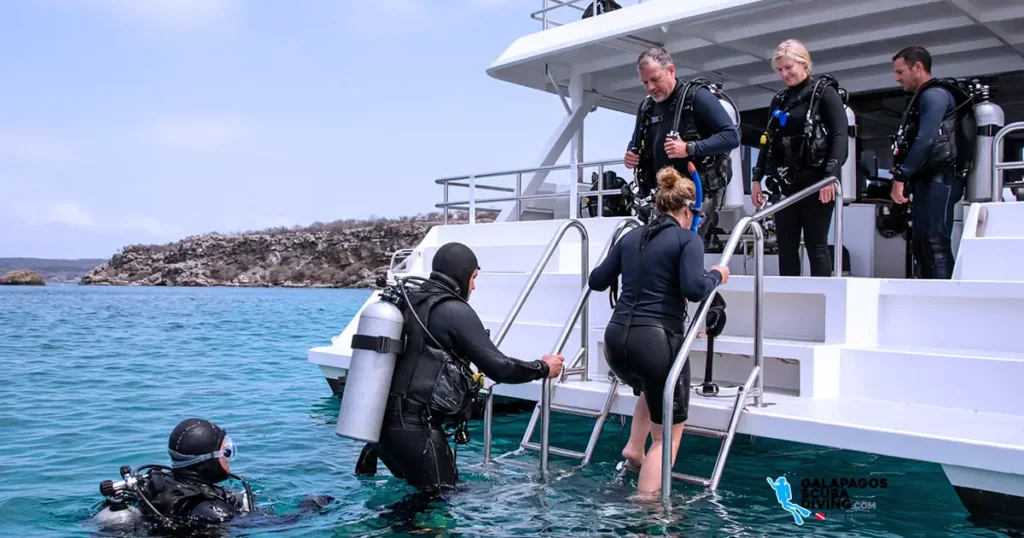
Divers boarding a Galapagos liveaboard after the flight from Europe to Baltra

Which airlines fly direct from Europe to Guayaquil?

Direct flights to Guayaquil leave from two European cities. Air Europa flies from Madrid, and KLM flies from Amsterdam almost every day, about six times a week. Both take around 12 hours. Other airlines reach Guayaquil with one stop, usually through Madrid or Amsterdam.

Schedules change with the season, so check days and times before you pick your boat dates. Round-trip fares from Madrid start around €540 in the cheapest months, March to May, and can pass €1,000 in August. We use €800 as a planning figure in our full euro budget.

How do you fly from Guayaquil to the Galapagos?

From Guayaquil, LATAM and Avianca fly to Baltra every day, about four flights a day between them, and the trip takes about 2 hours. Book a morning flight so you land well before 11:30 am. Your dive guides meet you at the airport, so you do not need to find the boat yourself. Independent travelers pay $5 for the airport shuttle, called Bus Lobito, but your dive guide boards you with the ticket already paid.

Baggage rules on this flight are strict, so check our baggage guide before you pack. The islands are one hour behind mainland Ecuador, so set your watch when you land.

What is the time difference between Europe and the Galapagos?

In winter, the Galapagos are 7 hours behind Madrid, Amsterdam, Warsaw, Prague and Budapest, and 8 hours behind Bucharest. In summer, add one hour. Europe moves its clocks on the last Sunday of March and of October; Ecuador and the islands never do. Our Galapagos time zone guide shows what the gap means for your flights and your schedule on board.
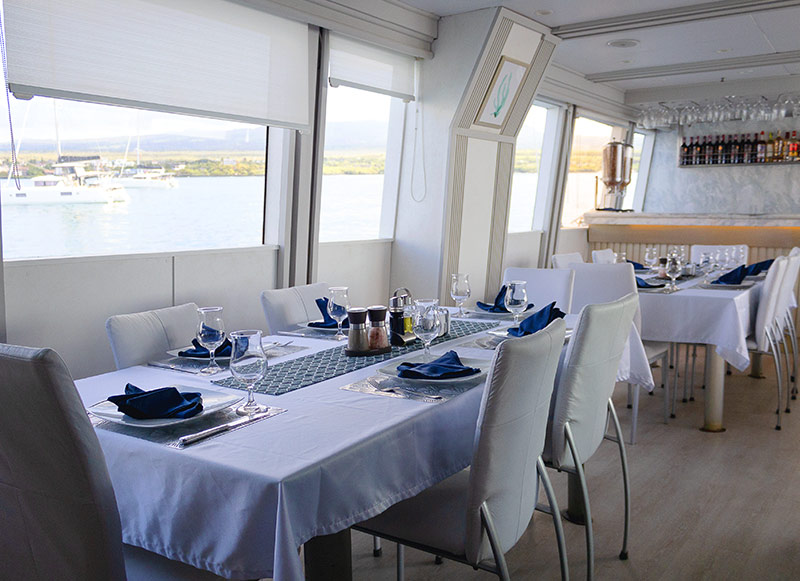
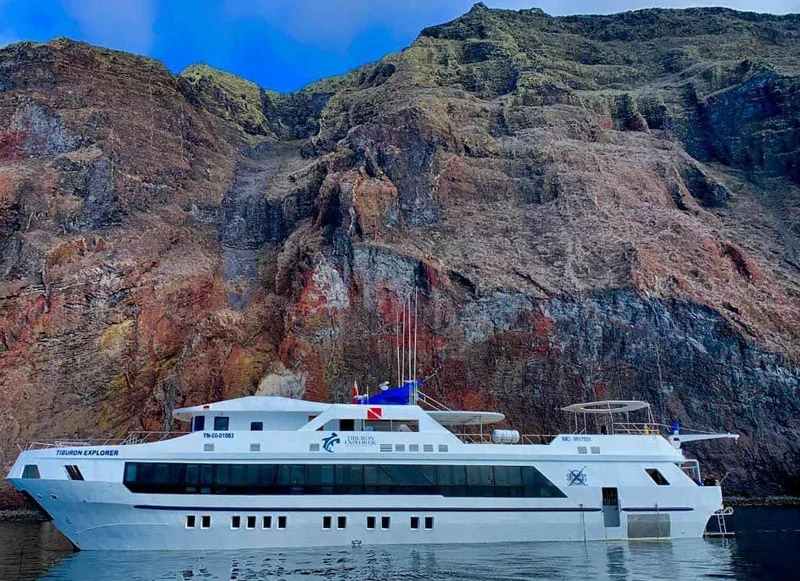
A Galapagos liveaboard at anchor, the only way to dive Darwin and Wolf

How do you get there from Warsaw, Prague, Bucharest or Budapest?

From Warsaw, Prague, Bucharest or Budapest you add one connection, usually in Madrid or Amsterdam. From Warsaw there is no direct flight; KLM via Amsterdam is the way to stay on one airline, and one-stop trips take roughly 13.5 to 15.5 hours in the air plus the layover.

If you buy your Europe flight and your island flight on separate tickets, a delay on the first one is not covered by the second. That is one more reason to arrive in Guayaquil a day early.

Why spend a night in Guayaquil before and after the boat?

We recommend one night in Guayaquil before the boat and one after. Before, because a delayed or cancelled flight would otherwise cost you the first day of diving. After, because long-haul flights home often leave in the evening, and a same-day connection after leaving the boat is too tight to be comfortable.

That is why our full euro budget includes two hotel nights. If you want to know how long the trip lasts once you are aboard, see how long a Galapagos liveaboard trip takes.

How much do the flights cost?

For planning, use about €800 for the long-haul round trip and about $600 for the round-trip island flight. Both are typical prices that change daily, so confirm them when you book.

Planning your route from Europe?

 Tell us your home airport and your dates, and we will tell you which departure fits best. Chat with us on WhatsApp.

Frequently asked questions about getting to the Galapagos from Europe

Fly to Guayaquil first, directly from Madrid or Amsterdam in about 12 hours, or with one connection from other cities. Then take a flight of about 2 hours from Guayaquil to Baltra, the island airport where your liveaboard starts.

No. There are no direct flights from Europe to the islands. Direct flights go to Guayaquil from Madrid and Amsterdam, and a second flight takes you to Baltra.

About 12 hours on the long-haul flight and about 2 hours on the island flight, plus airport time and any connection. Spread it over two days with a night in Guayaquil, and allow 10 to 12 days door to door for a 7-night liveaboard, or three more days for a 10-night one.

Land in Baltra before 11:30 am on the first day. Our dive guides meet you at the airport between 11:00 am and 12:00 pm and take you to the boat, with the airport shuttle ticket already paid.

Add one connection, usually in Madrid or Amsterdam, then fly on to Guayaquil. From Warsaw, KLM via Amsterdam keeps the whole trip on one airline, and one-stop journeys take roughly 13.5 to 15.5 hours in the air plus the layover.

Plan on about €800 for the round trip from Europe to Guayaquil and about $600 for the round trip from Guayaquil to the Galapagos. Fares from Madrid start around €540 from March to May and can pass €1,000 in August.

In winter the Galapagos are 7 hours behind Madrid, Amsterdam, Warsaw, Prague and Budapest, and 8 hours behind Bucharest. In summer the gap is one hour larger. Mainland Ecuador is one hour ahead of the islands.
Related Articles
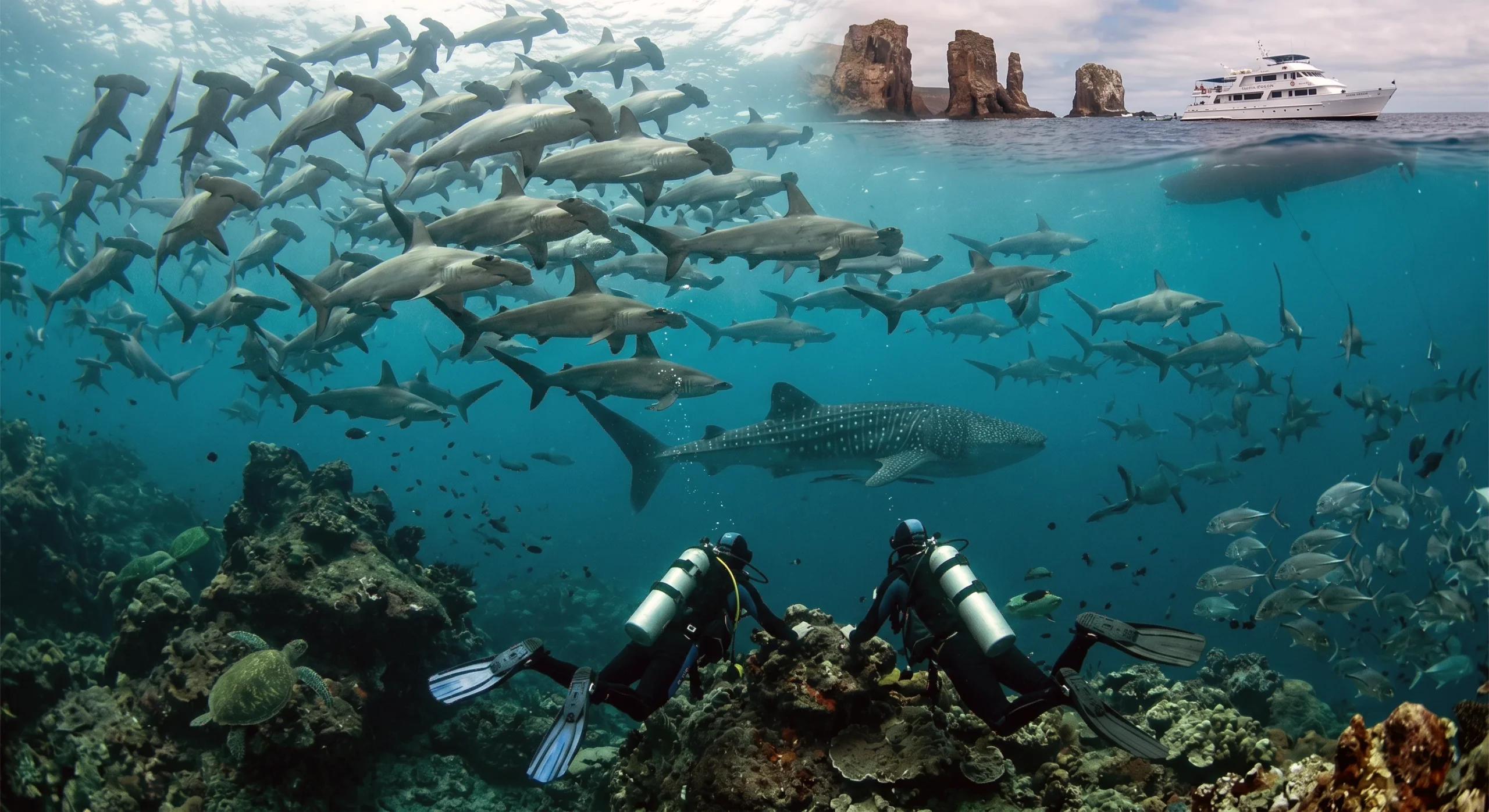
Dive with huge schools of hammerhead sharks in the Galapagos: where to see them, the best season and why Darwin and Wolf hold the biggest
How hard is Galapagos diving, how many dives you need, water temperature, currents and what to bring — everything to know before you dive Darwin
Marine iguanas of the Galapagos: the world’s only ocean-diving lizard, feeding on algae underwater and basking on lava rock between dives.

Itineraries - Humboldt Explorer

8 days/ 7 nights

Please note  that all trips onboard Humboldt Explorer are now operated from Baltra to Baltra (Airport code GPS). We will not sail from/to San Cristobal island anymore.

Monday: Baltra
Guests fly to the Galapagos Islands from Mainland Ecuador, arriving in the late morning (please make sure to land in Baltra not later than 11:30am). The dive guides will meet the guests at the airport between 11:00 am and 12 pm and escort them to the Galapagos liveaboard, Humboldt Explorer. Guests will board the vessel, have lunch, organize equipment and listen to the safety briefings.

Tuesday: Baltra North (2 Dives)
Equipement check, 7:00 and 10:00 dives.
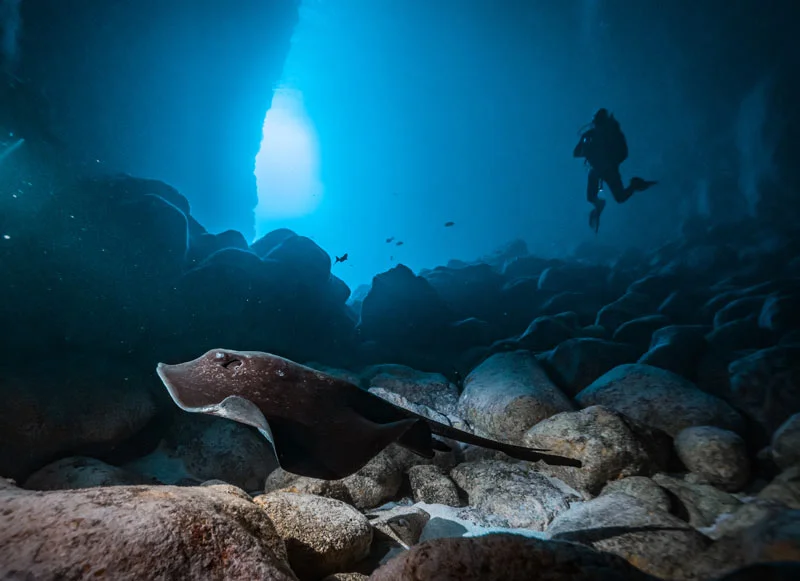
Sightings include rays and schools of fish.
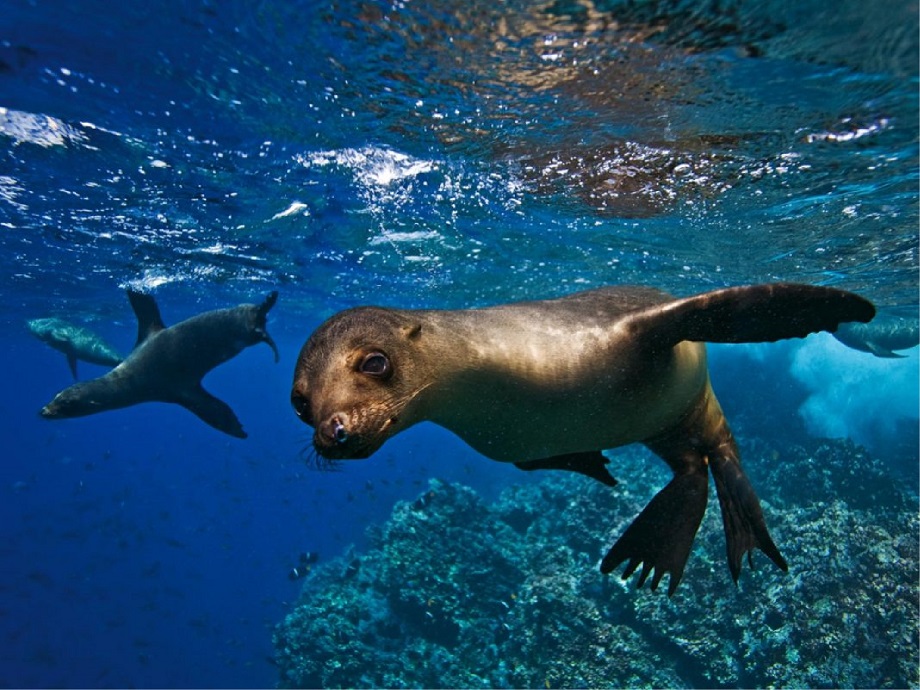
Afternoon North Seymour land visit. Walk the path around North Seymour Island to see the large colonies of Blue Footed Boobies and Frigate Birds. Sighting of Sea Lions and Marine Iguanas are also common.
Depart for Northern Islands (long transit).

Wednesday: Wolf Island (3-4 Dives)
10:30, 2:00 and 4:30 dives. Possible night dive.
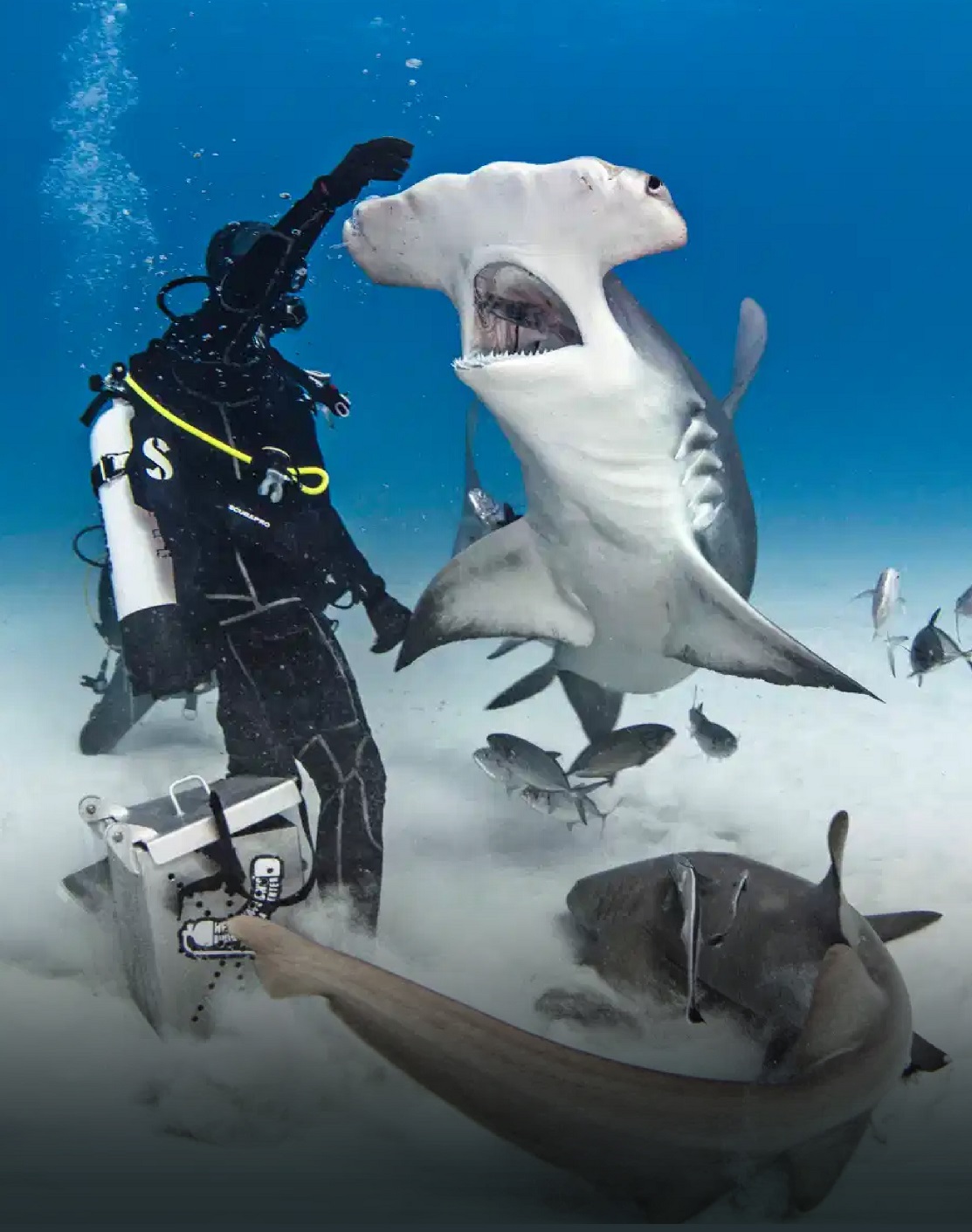
Sightings often include hammerheads, whale sharks, eagle rays, sea lions, Galapagos sharks, and silky sharks.
Night anchor at Wolf Island.

Thursday: Wolf Island (2 Dives)
6:30 and 9:30 dives.

Transit to Darwin Island (2 Dives)
2:00 and 4:30 dives.
Sightings often include hammerheads, red-lipped batfish, eagle rays, sea lions, Galapagos sharks, and silky sharks.

Friday: Darwin Island (4 Dives)
6:30, 10:30, 2:00 and 4:30 dives.
Sightings often include hammerheads, whale sharks (in season) eagle rays, Galapagos sharks, and silky sharks.
Transit to Wolf Island.

Saturday: Wolf Island (3 Dives)
6:30, 9:00 and 11:00 dives.
Sightings often include hammerheads, whale sharks (in season), eagle rays, Galapagos sharks, and silky sharks.
Long transit to Cousin’s Rock (20+ hours).

Sunday: Cousin’s Rock (1-2 Dives)
6:30 and 9:30 dives (number of dives dependent on travel time from Wolf Island).
This is great macro diving with an excellent chance of seeing sea horses, sea lions, and eagle rays. Lunch will be served while transiting to Santa Cruz (3 hours). Travel by bus to the Santa Cruz Highlands to visit the giant tortoises in their natural habitat. Visit the town of Puerto Ayora and the Darwin Centre on your own. Dinner on your own in Puerto Ayora. Return to the Humboldt Explorer at 8:30 pm.

Monday: Baltra
Depart the vessel by 9 am. Transfer to the airport.

Rates - Humboldt Explorer

Single supplement (for not sharing cabin) 80%.
All pricing is in US Dollars, per person double occupancy.

7 – Night Trips: 
January – June 2026$6,295
July 2026 – June 2027$6,395
July 2027 – June 2029$6,495
July 2029 – Dec. 2030$6,695
10 – Night Trips: 
No information yet – Ask: Form or WhatsApp 


INCLUDED

  • 7 nights/8 days or 10 nights/11 days aboard the vessel
  • Up to 4 dives daily (Weather Permitting).
  • 3 meals daily, except Sunday’s evening meal
  • Between-dive snacks
  • Towels, linens
  • Use of tanks, weights and weight belts
  • All air fills
  • Transfers between vessel and airport for same day arrivals & departures
  • Local alcohol
  • Non-alcoholic beverages

NOT INCLUDED:

  • Flights to/from Galapagos
  • Dive gear rental (Wetsuit, BCD, regulator, dive computer, fins, masks, booties, gloves, hoods)
  • Crew gratuities
  • Trip Cancellation & Dive Accident Insurance
  • Premium Alcoholic Beverages
  • Galapagos National Park tax – USD 200 per person, cash only.
  • Ingala Transit Card USD 20 per person, cash only).
  • Nitrox: USD 150 per person.
  • Fuel tax USD 150 per person

Diving Equipment Rental Prices Per Person Per Week

  • Full Scuba Package -BCD, Regulator, Console, wetsuit (does not include computer) $ 250
  • Regulator Package with gauges, octopus and inflator $ 90
  • Computer $ 100
  • BCD $ 90
  • Full Body Wetsuit $ 75 (7mm)
  • Mask & Snorkel $ 25
  • Fins/booties $ 50
  • DIN/Yoke Adaptor (limited availability) $ 25
  • 15 Liters Tank $ 130

Payment Terms

Deposit Required Upon Reservation: 30% of regular rate

Final Payment / Balance Due: 90 days prior departure

Individual Cancellation Terms

8 months to 12 months before departure: 10% of regular rate

6 months to 8 months before departure: 20% of regular rate

90 days to 6 months before departure: 30% of regular rate

89 to 0 days before departure: 100% of regular rate


Group Cancellation Terms

12 months to 18 months before departure: 5% of regular rate

8 months to 12 months before departure: 10% of regular rate

6 months to 8 months before departure: 20% of regular rate

90 days to 6 months before departure: 30% of regular rate

89 to 0 days before departure: 100% of regular rate

Tiburon Explorer’s itinerary

8 days/ 7 nights

Saturday: Baltra
Guests fly to the Galapagos Islands from Mainland Ecuador, arriving in the late morning (please make sure to land in Baltra not later than 11:30am). The dive guides will meet the guests at the airport between 11:00 am and 12 pm and escort them to the Galapagos liveaboard, Tiburon Explorer®. Guests will board the vessel, have lunch, organize equipment and listen to the safety briefings.

Sunday: Baltra North (2 Dives)
Equipment check, 7:00 and 10:00 dives.
Sightings include rays and schools of fish.
Afternoon North Seymour land visit. Walk the path around North Seymour Island to see the large colonies of Blue Footed Boobies and Frigate Birds. Sighting of Sea Lions and Marine Iguanas are also common. Depart for Cabo Douglas (11 hours).

Monday: Cabo Douglas (1-2 Dives)
Sightings include marine iguanas. Transit to Punta Vicente Roca.

Punta Vicente Roca (1-2 Dives)
Sightings often include mola mola, turtles and macro life. Transit to Wolf (10 hours).

Tuesday: Wolf Island (4 Dives)
6:30, 10:30, 2:00 and 4:30 dives. Sightings often include hammerheads, whale shark (in season), eagle rays, sea lions, Galapagos sharks and silky sharks.

Wednesday: Darwin Island (4 Dives)
6:30, 10:30, 2:00 and 4:30 dives.
Sightings often include hammerheads, whale sharks (in season) eagle rays, Galapagos sharks and silky sharks. 
Transit to Wolf Island.

Thursday: Wolf Island (3 Dives)
6:30, 10:30 and 1:00 dives.
Sightings often include hammerheads, whale sharks (in season), eagle rays, Galapagos sharks and silky sharks. Transit to Cousin’s Rock (20+ hours).

Friday: Cousins Rock (2 Dives)
6:30 and 9:30 dives.
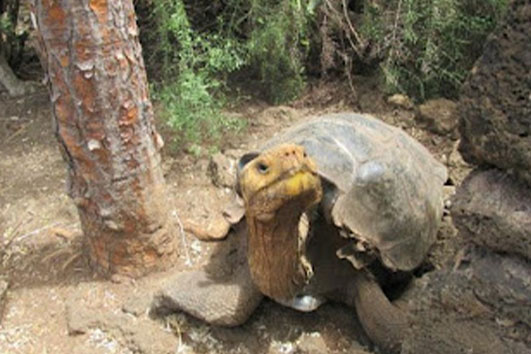
This is a great macro diving with an excellent chance of seeing sea horses, sea lions and eagle rays. Lunch will be served while transiting to Santa Cruz (3 hours). Travel by bus to the Santa Cruz Highlands to visit the giant tortoises in their natural habitat. Transfer to the town of Puerto Ayora. Dinner on your own in Puerto Ayora. Return to the Tiburon Explorer at 8:30pm.

Saturday: Baltra
Depart the vessel by 9 am. Transfer to the airport.